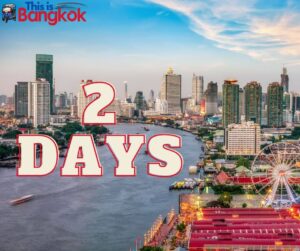
Bangkok, one of Southeast Asia's
most thriving commercial centres. Bangkok has been voted Asia's
No 1 and world's No's 4 destination by Conde Nast Traveler Magazine
Reader's Choice Awards. Scoring high for scenic beauty, unique
arts and and culture , good restaurants, hospitality, value-for-money
and shopping facilities. |
BANGK0K METROPOLIS
Bangkok
Metropolis lies on both banks of the Chao Phya, the main river
of Thailand, 20 kms upstream from the Gulf of Thailand. King Rama
1, the founder of the present Chakri Dynasty built the present
capital in Bangkok in 1782. The Royal Founder took great care
to build palaces and temples of the new capital in the same style
of Ayuthaya, the previous capital, which in turn had its origin
from Sukhothai, the first Thai capital built in the 13th century.
Both former capitals, now national historical parks, have been
placed in the UN's list of world cultural heritages. The name
Bangkok appeared on international navigation charts as far back
as the 15th century as an outpost port of Ayuthaya, the former
capital where western merchant ships made frequent calls. However,
Bangkok has got an official name, so auspicious and long that
it goes into the Guinness Book as the longest in the world for
a city. In short, the official name is "Krung Thep"
meaning "The City of Angels", the same name as Los Angeles,
which incidentally has a sizable Thai community numbering over
300,000 ethnic Thais, the largest outside Thailand.
More
than anywhere else in the country, Bangkok expresses Thailand's
uncanny ability to blend the old with the new. This lends a thrilling
sense of discovery to one's sightseeing and adds an element of
surprise when exploring what is the Orient's most fabled city.
Joyfully exuberant, Bangkok embraces modern development and presents
an initial picture of thrusting office towers; of world-class
hotels offering deluxe comforts; of glittering shopping plazas
packed with treasures of the East such as silks and gemstones;
of restaurants serving Thailand's acclaimed spicy specialities
and virtually every other national cuisine worthy of the name;
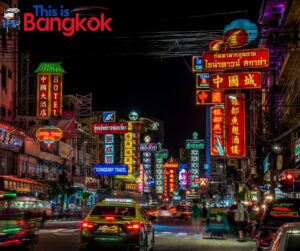
of neon-lit entertainment spots where the fare ranges from classical
dance to laser disco.
Incredibly amidst this sybaritic world Bangkok manages to preserve
its cultural heritage to an amazing degree. In the rich splendour
of the Grand Palace, the Temple of the Emerald Buddha, the Temple
of the Dawn and other historic shrines, you see images of medieval
Oriental wonder, the very stuff of Eastern fairy tales.The influence of the past is not limited to
major monuments and it continues to colour daily life. Files of
saffron-robed monks making their early morning alms round, for
example, present a scene unaltered in essentials by the passing
of time. Today's backdrop of highrise buildings only adds wonder
to this and other enduring sights from which the city continues
to draw definition.Ultimately it is from the people that Bangkok
derives its unique flavour. Fun-loving and easy going, they possess
a rare tolerance which imbues the city with a real sense of freedom.
It may appear at times hectic, yet what finally comes across is
Bangkok's good natured acceptance of life with all its idiosyncrasies.
Thailand's "City of Angels" is,
indeed, a magic place where possibilities are limited only by
the imagination. You'll marvel at past glories, delight in present
opportunities and love every minute of it.
|
| Getting Around
BUSES
The
ordinary city buses are not air-conditioned and are usually crowded
during peak hours but their frequency is good. There are two types
of ordinary buses - the blue and the red ones. Besides, there
are smaller private buses. The blue buses and the smaller private
buses charge Bht. 2.50 and the red buses charge Bht. 3.50 throughout
the routes. Though comfortable for most of the day, the air-conditioned
buses are packed to capacity by office-workers during the morning
and evening rush hours. The fares on the blue buses range from
Bht. 6 for a distance of up to 8 km. to a maximum of Bht. 16.
And from Bht 8 on the orange buses. Most maps of Bangkok indicate
the numbers of air-conditioned buses and their respective routes.
Smaller than the blue air-conditioned buses, micro
buses operate on some of the major routes in the city. The seats
have enough leg space. For the convenience of the passengers,
the buses carry a stock of Thai-language magazines. Video entertainment
also is available on board.
TAXIS
With
the recent introduction of metered taxis, it has become very convenient
for visitors to hail them and go to any destination without any
haggling over fares. The metered taxis have a sign "Taxi
Meter" on their roofs. The minimum fare is Bht. 35 for a
distance of no more than 2 km. The fare increases according to
the distance covered. For example, for a journey of 5 km, the
meter will show Bht. 49, for 10.99 km, the charge will be Bht.
71, for 18.99 km, the meter will show Bht. 99, and Bht. 125 for
a distance of 26.39 km. These rates are based on a travel speed
of over 6 km per hour. If the speed is slower, a surcharge of
one baht per minute is added automatically. In case of travel
by expressway, the toll is payable by the passenger.
Sky
Train Stations
The typical station consists of two levels - concourse
and platform. The concourse provides ticketing facilities and
other passenger amenities as well as access to the system. The
platform is for waiting, boarding and alighting from the train.
Please be aware that the train may approach the platform anytime,
from any direction.
Bangkok Hotels Near Skytrain stations
Trains
Our trains are designed to high international standards. Doors
open / close automatically. Beeper sounds will warn you when the
doors are about to close. If standing please stand clear of the
door's at all times.
Track
Stay away from the track and electrified rails. Pay attention
to all warning signs. Trespassing onto the track area can cause
severe injury to yourself or others.
Fares
About 10 to 40 that depend on your destination
TUK-TUKS
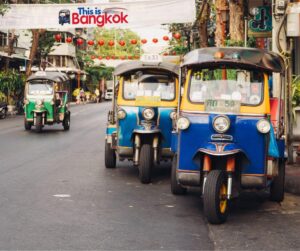
These three-wheeled automobiles are best used for covering short
distances. Less convenient than taxis, the tuk-tuks are considered
a faster mode of transport. They are also cheaper than ordinary
taxis but fares must be negotiated before boarding.
PRIVATE
CARS & VANS
Bangkok has a number of private car rental agencies
with fleet of modern cars and vans. Chauffeur-driven cars can
be rented from the agencies. To rent a car the driver must be
over the age of 21 years and hold a full license either in Thai
or from the rentes country of origin, with an English translation.
Hertz, Avis and Budget are the most popular rental companies in
Thailand.
MOTORCYCLE TAXIS
Riding as a pillion on a motorcycle taxi is the
fastest way to travel around the city, as they can dart through
the non-moving traffic. When using a motorcycle taxi there is
a legal requirement to wear a crash helmet.
FERRY
SERVICES
Traveling
by ferry is a fun way to cross the Chao Phraya River. It's also
a cheap way to travel up and down the river.
|
| Cultural Attractions
THE
SIAM SOCIETY
Founded
in 1904 under Royal Patronage, the organization helps those interested
in the artistic and cultural life of Thailand and neighboring
countries. The Society maintains an excellent library (for members
only); publishes an esteemed journal; and organizes monthly lectures,
exhibitions, and study trips. It has a natural history section
too. An ethnological museum providing traditional Thai artifacts
and carvings is housed in the Kamthieng House on the grounds of
the Society. It is open Tue to Sat 9 am - 12 noon and 1-5 pm.
The address is 131 Sukhumvit 21 (Soi Asoke), Bangkok 10110.
THE
NATIONAL MUSEUM
Within walking distance of the Grand Palace, across the Pramane
Ground, is one of the largest and most comprehensive museums in
Southeast Asia. The National Museum over one thousand artifacts
ranging from neolithic times to the present Bangkok period. The
complex, also begun in 1782, consists of several old hut beautiful
buildings of colourful Thai architectural design. The museum is
open every day, except Mondays, Tuesdays and public holidays from
9.00 a.m.- 4.00
NATIONAL
THEATRE
Just around the corner from the National Museum
is this huge building where drama and Thai classical dance performances
are presented. There is a dance exhibition on the last Friday
of every month at 5 pm. Admission fee for other shows is around
Bht 30. Call 224-1342 for further details.
THE
NATIONAL ARTS GALLERY
This is on Chao Fa Road opposite the National Theatre. It exhibits
traditional and contemporary works of art by Thai artists. The
gallery is open to the public everyday except Mondays Tuesdays
and public holidays from 9.00 a.m.- 4.00 p.m. The telephone number
is 2812224, 2822639 . Admission fee is Baht 10.
THAILAND
CULTURAL CENTER
Avenue for musical and visual entertainment, this
spacious complex was established with Japanese assistance. Its
monthly programme often lists artists from abroad. It is located
on Ratckadapisek Road, behind an open automobile showroom directly
opposite the Siam Jusco shopping mall.
NATIONAL
LIBRARY
This public library has a good collection
of books in English and some other European languages on wide
ranging topics. Located at the intersection of Sri Ayutthaya and
Samsen Roads, the library is open from 8.30 am to 6 pm; Mon. through
Sat. The National Archives office is located in the some premises.

|
| Exploring Bangkok
THE SHED OF THE ROYAL
BARGES
This shed where several royal barges are displayed
is located on Khlong Bangkok Noi off the Chao Phraya River not
far from Phra Pin Klao Bridge. These barges were used on Royal
and government occasions and formerly served war vessels. The
most beautiful and well-known barge is "Suphanahong"
used by the King only when he made his Royal river procession
for the Kathin ceremony a Buddhist tradition of offering robes
to monks usually during October or November. The Royal barges
proceeded during the Rattanakosin Bicentennial celebrations. The
unique design and decorative details of each barge should be of
great interest to all visitors. The shed is open to the public
every day from 8.30 a.m.- 4.30 p.m. There is an admission fee of 10 baht.
ERAWAN
SHRINE
Thailand's devotion to Hindu deities is best represented
by the famous shrine at the Ratchadamri traffic junction, where
the Grand Hyatt Erawan Hotel stands.To boost their fortunes or success in their ventures,
be it studies or business, Thais make offerings at the statue
of the Hindu God Brahma. Originally erected by Grand Hyatt Erawan
to counter a series of accidents during the construction, the
shrine is now redolent with incense smoke and jasmine. To repay
the deity for fulfilled wishes devotees place wooden elephants
around the shrine or hire a resident troupe to dance.
DUSIT ZOO
This
is one of the most popular places in Bangkok for family outings,
especially on weekends. Located on Rama V Road, the zoo is spread
over 47 acres. The main entrance to the zoo is on Rajvithi Road.
The zoo is also known as Khao Din Zoo. The place is so-called
because its central topographical feature is a manmade hill which
gives a view of the entire park. Formerly a part of the Royal Dusit Garden Palace,
the Dusit Zoo was set up by King Rama V as his private botanical
garden. The zoo houses a fine collection of birds and animals,
including the white elephant. It is open 8 a.m.-6 p.m.
LUMPINI PARK
It
stands like an oasis amid a concrete jungle. Named after Lord
Buddha's birthplace, this park is an ideal place to take a break
from the hectic pace of life and give your lungs a fresh breath
of air. In an artificial lake at the park, ducks and paddle boat
fans can be seen moving around unmindful of the travails of Bangkokians
on the roads. The main entrance to the park is opposite the
Dusit Thani Hotel on Rama IV Road where the statue of King Rama
IV stands.
THE GRAND PALACE
AND WAT PHRA KAEO
This
city landmark should be the first place on any visitor's itinerary.
It is a huge compound on Na Phra Lan Road near Pramane Ground
is surrounded by high white walls and occupies an area of about
a square mile. The palace, begun in 1782, consists of several
buildings with highly decorated architectural details. The Royal
chapel, Wat Phra Kaeo, which is in the same compound, houses the
Emerald Buddha, the most sacred Buddha image in Thailand. Photography
inside the building housing the Emerald Buddha is forbidden. The
complex is open daily from 8.30 a.m.- 3.30 p.m. Admission fee
is 125 baht(including tickets to The Coin Pavilion & Phra
Thi Nang Vimanmek & Abhisek Dusit Throne Hall). Proper dress
is essential.
PHRA THI NANG
VIMANMEK AND ABHISEK DUSIT THRONE HALL
Vimanmek
Palace is located behind Bangkok's National Assembly and is the
world's largest building made entirely of golden teak . The three
storey wooden palace has 81 rooms, halls and ante-rooms, excluding
and verandahs. Near the entrance to Vimanmek Palace is the Royal
Carriage Museum where 13 royal horse-drawn carriages once used
during the reign of King Rama V are collected. The collection
is so splendid and regarded to be of great historical value. Abhisek Dusit Throne Hall (The Support Museum),
a one storey teak building built in the reign of King V, is situated
on the east wing of Vimanmek Throne Hall. Abhisek Dusit Throne
Hall is now Thailand's first handicraft museum where Her Majesty
The Queen collects handicraft asterpieces created by members
of Support Foundation . In the museum, visitors find such handicrafts
as niellowares Thai silk with various unique designs,"Lipao"basketry
like beautiful trays, handbags studded with jewels in different
designs such as green beetle. The compound is open daily from 9.00 a.m.- 4.00
p.m. Admission fee is Baht 50 per person. Free guide available
SUAN PAKKAD
PALACE
On
Si Ayutthaya Road not far from the intersection of Phaya Thai
Road used to be the residence of Princess ChumShol of Nagara Svarga
one of Thailand's leading art collector. There is a complex of
five traditional Thai Houses overlooking a beautifully kept garden.
They house a large collection of Asian art and antiques. One building
exhibits a collection of seashells mineral crystal and painted
pottery from Ban Chiang. Suan Pakkad Palace is open everyday except Sunday
from 9.00 a.m.- 4.00 p.m. There is an admission fee of Baht 80.
JIM THOMPSON'S
THAI HOUSE
This
remarkable Thai-style house was the work of Mr. Jim Thompson an
American who came to Thailand at the end of the Second World War
and revived the Thai Silk industry. His later disappearance in
the Malaysian jungles remains a mystery to this day. The house
now a museum is at the end of Soi Kasemsan 2 opposite the National
Stadium on Rama I Road.
On permanent display are Mr.Thompson's collection of Asian artifacts
such as blue-white China ware Cambodian stone figures benjarong
(a multi-couloured porcelain made in China) wooden Burmese statues
and many other fabulous antiques. Jim Thompson's House is open
from Monday to Saturday inclusive from 9.00 a.m.- 4.30 p.m. Admission
costs Baht 100. Volunteer guides explain the collection to visitors.
PASTEUR INSTITUTE
(Snake Farm)
This
interesting spot is located at the corner of Henri Dunant Road
and Rama IV Road west of Chulalongkorn Hospital. It is a section
of the Thai Red Cross where one can have cholera smallpox and
typhoid inoculations as well as rabies treatment. The institute
has become a popular tourist attraction because of its large collection
of live poisonous snakes. The Snake Farm is open to the public every day
between 8.30 a.m. and 4.00 p.m. on weekdays and 8.30 a.m.- 12.00
p.m. on public holidays. The extraction of venom from the snakes
is demonstrated daily at 10.30 a.m. and 2.00 p.m. on weekdays
and at 10.30 a.m. on public holidays. Admission fee is 70 baht.
LABOUR MUSEUM
Located
near Makkasan Railway Station Nikhom-Makkasan Road Phayathai .
Here labour history of Thailand from the past to present is put
on exhibition.
The museum is open daily with no admission fee during 10.00 a.m.-
5.00 p.m. except for Mondays Tuesdays and national holidays.
MUSEUM OF
IMAGING
The
first camera and photograph museum to be established in Thailand
and Asia is located at the same building as the Department of
Photographic Science and Printing Technology. Faculty of Science
Chulalongkorn University. Historic photograph sand imaging equipment
as well as its technological evolution are collected and displayed
in the form of camera and imaging technology museum. Modern photographic
arts and techniques as well as advanced technology of the dimensional
photographs, electronic photography, and printing technology are
also exhibited. The museum is open on Saturday between 10.00 a.m.-
4.00 p.m. Admission fee is Baht 100 each. It is also open on weekdays
for group visitors making advance contact.
HALL OF RAILWAYS
HERITAGE
It
is located to the North of Chatuchak Park near a multipurpose
parking lot, is where railway information is collected for publicity.
Steam engines, train models, and miniature trains of various sizes
are exhibited there along with photographs and paintings depicting
development of world railway systems and several other related
objects. The Hall of Railways Heritage is open every Sunday between
5.00-12.00 a.m. Admission is free. For more information please
contact the Thai Rail Fan Club.
PRASART MUSEUM
It
is located at 9 Soi Krungtepkreetha 4, Si Nakharin Road, Phra
Khanong, houses a vast collection of artifacts from pre-historic
through Rattanakosin periods. Various styles of architecture,
for example, a baroque building, a smaller version of the Red
Palace in Bangkok National Museum, and an imitation of Ho Phra
of Wat Yai Suwannaram, are scattered within the museum complex.
Prasart Museum is open on Fridays, Saturdays, and Sundays during
10.00 a.m.- 3.00 p.m. Admission fee is Baht 300 each (snack and
beverage included).
It is also open on weekdays for group visitors.
BANGKOK PLANETARIUM
& SCIENTIFIC MUSEUM
The
scientific museum situated next to the Eastern Bus Terminal(Ekamai)
is an exhibition center on scientific knowledge and astronomy.
Open daily, except Monday and national holidays, from 9.00 a.m.-
4.00 p.m. Admission fee is Baht 10.
At the planetarium, daily performances on the solar system are
presented for the public from Tuesday to Sunday. Open from 8.30
8.30 a.m. p.m. Admission fee is 10 baht.
BANGKOK DOLLS
& MUSEUM
All kinds of Thai dolls are made in this factory which is on Soi
Ratchataphan (Soi Mo Leng) off Ratchaprarop Road, in the Pratunam
area.
It is open to visitors, who may inspect and buy dolls, every day
except Sundays and public holidays from 8.00 a.m.- 5.00 p.m.
SIAM WATER PARK
Siam Water Park is merely a 30-minute drive from the Lat Phrao
fly over, and is located in suburban Amphoe Minburi. The park
features an extensive man-made sea with artificial surf, whirlpools,
fountains and waterfalls, and towering water slides amid carefully
landscaped gardens. Satellite attractions include children's playgrounds,
aviaries, an open zoo and botanical gardens. The complex is open
daily
from 10.00 a.m. to 6.00 p.m. (weekdays) and 9.00 a.m. to 07.00
p.m. (weekends). Admission fee is 200 baht for adults and 150
baht for children. Bus service: No. 26 & 27 from Victory Monument.
SAFARI WORLD
It
is located at 99 Ramindra 1, Min Buri, covers an area of some
430 rai and is divided into 2 parts. The first, the Safari Park,
houses a large variety of animals like zebra, deers, giraffe,
birds, tigers, lion, bears, etc. in natural habitat. Visitors
can drive their own cars or have a good look from one of the Safari
World's air-conditioned coaches . The second, the Marine Park,
exhibits marine and some rare animals. Visitors can enjoy performances
by trained animals like dolphins, birds, seals, and monkeys Restaurants
and game shops are also scattered within the area and tram service
is provided for those wishing to have a look around. Safari World is open daily between 9.00 a.m. Admission
fee is 400 baht for adults and 300 baht for children. For more
information please call 5181000-19
Bus services: No. 26 from Victory Monument goes to Minburi, from
where a mini bus service serves Safari World.
MAGICLAND
A large scale amusement park is located on Phaholyotin Road on
the way to Domuang Airport. Within its beautifully decorated area,
there are linked paths, pools, legendary castles and more than
30 funny toys. Opening time is from 10.00 a.m.- 5.00 p.m. on weekdays
and 9.30 a.m.7.00 p.m. on weekends. Admission fee costs 100 baht
per person. The price plus service charges is 200 baht a person.
OLD
TOWN - CHINATOWN
In the old Bangkok town are located the Grand Palace, the Temple
of the Emerald Buddha, the Temple of the Reclining Buddha, two
universities and several ministries. It is from this side of the
Chao Phraya River that one takes a boat to visit the Temple of
Dawn and the floating market. Chinatown is situated to the southeast
of the old town . The gold shop street and the Temple of the Gold
Buddha are located here.
PINKLAO
A bridge was built across the Chao Phraya River near the Grand
Palace in 1973. It was named Pin Klao in memory of the last but
one deputy king, whose palace was nearby. Now the area on the
western side of the river has become one of the most newly developed
areas in Bangkok with several department stores, many restaurants
and nightlife establishments.
RATCHADAPHISEK
Ratchadaphisek is the name of the new sections of the inner ring
road of Bangkok but is usually used to refer to the short section
between the Lat Phrao intersection and the Rama IX Road intersection.
This section is being developed into a new commercial district
containing several big department stores, office buildings, hotels
and a large number of restaurants, A little way off the road is
Thailand Cultural Centre, where shows and exhibitions are held
from time to time.
RAMKHAMHAENG
When Ramkhamhaeng University was founded on Bangkok's eastern
outskirts as Thailand's first open university in 1970, the area
was rather remote and underdeveloped. However, as the university's
yearly enrollments increased rapidly to 100,000, the area soon
became
a new satellite city of Bangkok with ever-increasing shop-houses,
apartment buildings, restaurants, cinema houses, department stores,
hotels and places of entertainment.
SIAM - RATCHADAMRI
This is one of the biggest and busiest shopping districts in Bangkok.
A huge commercial complex, including a 62-storey World Trade Centre
opposite Ratchadamri Arcade, is partly completed. Located in the
area are several large department stores, shopping arcades, cinema
theatres, and countless smaller shops. So you can satisfy all
your needs if you stay in one of over a dozen first-class hotels
in the area. The Pratunam Market next to the Indra Arcade,
is worth visiting if you want to broaden your field of vision.
It is also the market of garments for export.
SUKHUMWIT-NEW
PHETBURI
In the section from the Soi Nana crossroads to Soi Sukhumwit 21
(Asok Intersection), there are many shops catering to foreign
tourists, where jewellery, leather goods, ready-made garments
and souvenirs are sold and tailoring, car rent and other service
are offered. Inside the lanes (soi) off the road, there are numerous
fashionable residences, hotels, apartment houses, and some really
good restaurants. To the north of Sukhumwit Road is the extension
of Phetburi Road which does not have many pedestrians in the daytime.
After dark, however, the long street is brightened with colourful
neon signs and enlivened by people going out to enjoy themselves
in dozens of entertainment places along the street.
Sukhumvit Road Hotels - Preview
SILOM-SURAWONG
This
district has transformed in half a century from paddy fields into
the most important business and financial centre of Bangkok .
Today, from end to end, these two parallel streets are full of
big blocks of multistory buildings, in which are banks, finance
firms, insurance companies, export-import houses, hotels, airlines
offices, restaurants, shopping arcades, department stores, and
entertainment establishments. A small area in this district known as Patpong,
is famous for various kinds of entertainment--wine, beer, music,
dancing, etc.
Silom Road Hotels - Preview
BANG LAMPHU
A
shopping area once frequented solely by local people has become
a popular place for tourists. This area offers various inexpensive
items, especially ready made clothes, handbags, men's and lady's
shoes, cosmetics and curios. Bargaining is recommended.
Khoasan Road Hotels - Preview
WEEKEND MARKET
AT CHATUCHAK PARK
This large open public ground covers approximately 35 acres opposite
the Northern Bus Station on Phahonyothin Road. Known as Suan Chatuchak,
it hosts the popular Weekend Market where people buy and sell
a thousand local products. Items range from exotic fresh fruits,
vegetables, handicrafts, dress materials, clothing shoes, toys,
domestic utensils and pets. There is a particularly fine section
for plants. Weekend Market is open on Saturdays and Sundays
from 7.00 a.m. - 6.00 p.m.
SANAM LUANG
This
huge public ground in front of the Grand Palace used to be the
place where the Weekend Market now moved to Suan Chatuchak on
Phahonyothin Road was held. Special activities or ceremonies such
as the Royal Ploughing Ceremony in May and the New Year Festival
also take place here. At the northern part of Sanam Luang opposite
the Royal Hotel is a small statue placed in small white pavillion.
The Goddess of the Earth was built during King Chulalongkorn's
reign (1868-1910) to provide public drinking water.
THE CITY PILLAR SHRINE
Located
at the southeast corner of Sanam Luang this graceful temple-like
Structure houses "Lak Muang" a stone pillar placed there
by King Rama I, the first monarch of the present Chakri dynasty,
as the foundation stone for his new capital city of Bangkok. Lak
Muang is believed by many people to have the power of granting
wishes.

|
| Day Trips From Bangkok
Exploring Bangkok alone could take weeks,
but because of the short duration of their visit to Thailand tourists
like to visit the main places in Bangkok and then go on day-tips
to nearby places. Almost all tour operators offer packages to
nearby attractions. Among the most popular places are the Floating
Market, Ayuthaya, Bang Pa-in and the Crocodile Farm.
CROCODILE FARM
Known
as the Samutprakarn Crocodile Farm and Zoo, it lies 30 kilometres
southeast ofangkok. Founded in 1950, the farm has over 40,000
crocodiles of 28 different species, some of them no longer in
existence elsewhere. The farm was acknowledged by the Guinness
Book of World Records for holding the largest crocodile ever held
in captivity. The Estuarine/ Siamese hybrid named 'Yai' measures
six metres in length and weighs 2,465 pounds. The highlight of the visit to the farm is a show
in which handlers go into a pond full of crocodiles and handle
them by their tails rather roughly. The ferocious reptiles seem
to obey the orders quite obediently, except for some stubborn
ones. Besides crocodiles, the farm also has other zoological
amusements. There are elephants, which dance to disco music, gibbons,
which are now on Thailand's protected species list, a collection
of poisonous snakes, lions, tigers, a tame python, a black bear
and a host of other birds and animals. The farm is open daily from 8 a.m. to 6 p.m. Admission
fee is Bht. 200, which includes the crocodile wrestling and elephant
show.
ANCIENT CITY
A
few kilometres from the Crocodile Farm is the Ancient city, which
bills itself as the 11 world's largest outdoor museum. Spread
over 81 hectares of what were rice fields, it took three years
to construct. The complex has scale replicas, some full size,
others one-third the size of the original, of famous monuments
and temples from all parts of the kingdom. Some of them are reconstructions
of buildings that no longer exist, like the Grand Palace and Royal
Chapel of Ayuthaya. In addition to the monuments, the Ancient
City has a model Thai village, in which you can see artisans at
work on various native handicrafts like lacquer ware, ceramics
and paper umbrellas. The complex takes an entire day to cover
as each building is situated according to its actual geographical
location to give an idea of regional variations in architecture.
It is open daily from 8.30 a.m. to 6 p.m.
FLOATING MARKET
One
attraction that is almost certainly on any visitor's agenda is
the Floating Market at Damnern Saduak. The trip to the market
starts very early in the morning from one of the many piers along
the Chao Phraya river. In a comfortable boat, you get to sail
along one of the major canals of the city witnessing scenes of
Thai life along the banks. Men and women wearing straw hats can
be seen transporting their merchandise to the Floating Market
in their longtail boats. The market is specially famous for its
fruits, particularly large, succulent pomelos. Early morning is
the ideal time for visiting the Floating Market because around
9 a.m. the place is deluged by thousands of tourists and there
seems to be a traffic jam even along the waterways.
AYUTHAYA
Situated
some 89 kilometres to the north of Bangkok, Ayuthaya is the former
capital of Thailand (1350-1767). It was completely destroyed by
retreating Burmese forces in 1767 but the ruins still bear witness
to its former splendour. Archaeological excavation of the site,
on which Chao Sam Phraya Museum also stands, is still continuing
and some of the ruins have been restored. During its hey day, Thai culture and commerce
flourished there as the English, French, Dutch, Portuguese and
Spanish held their trading posts in Ayuthaya. Today Ayuthaya is a bustling country town sprawled
along the main street from the Pridi Damrong Bridge to a little
beyond the Chandrakasem Palace. There are two museums in Ayuthaya namely Chao
Sam Phraya and Chan Kasem. The former, in the centre of the town
on Rajana Road, contains a superb collection of terracotta, bronze
and stone statues mostly from the Ayuthaya Period and some belonging
to the Lopburi and U-Thong styles. Probably the best way to reach Ayuthaya is by
boat, though bus and train services also are available. Several
cruises run daily between Bangkok and Ayuthaya, bookings of which
can be made either at the travel agencies or at the travel desk
in most of the hotels.
BANG PA-IN
PALACE
About
60 kilometres from Bangkok on the river route to Ayuthaya, the
Bang Pa-in Summer Palace is a charming collection of palaces and
pavilions once used by the kings of Thailand as a summer retreat. Although the Bang Pa-in Palace itself presents
some fine examples of Thai architecture, the surrounding palace
complex illustrates Thailand's fondness for adaptation, with two
buildings in the classical Greek architectural style, a Gothic
church and a replica of the Imperial Palace of Beijing. A Thai-style pavilion called Aisawan Thipaya-art
in the middle of the lake is regarded as one of the finest examples
of Thai architecture. The many pools scattered around the complex enhance
the graceful lines and bright colours with perfect reflections
in their still waters. The palace complex is open everyday, except Monday,
from 8.30 a.m. to noon and 1 p.m. to 4 p.m.
ROSE GARDEN
Thirty-two
kilometres west of Bangkok lies a resort which is very popular
both among Thai people and overseas visitors. Known as Suan Samphran,
the Rose Garden is a combination of beautifully-landscaped gardens,
a modern hotel with convention rooms, several classy restaurants,
a swimming pool, a golf course, a bowling alley, and a model Thai
village. Also available are facilities for boating and water-skiing
on the lake. The highlight of the resort is a traditional Thai
cultural performance amidst the Thai cultural village setting.
The performance includes Thai folk dances, classical dances, sword
fights, Thai boxing, a Buddhist ordination ceremony, and an elephant
show.
NAKHON PATHOM
Just
54 kilometres west of Bangkok is the city of Nakhon Pathom where
Buddhism is believed to have been introduced to Thais. Its colossal
landmark seems to tower over the surrounding countryside. Standing
127 metres high, Phra Paithom Chedi is the tallest Buddhist monument
in the world. In the days of canal travel, a royal visit to
Nakhon Pathom involved more than a day's journey. Hence it is
not surprising that various palaces and residences were built
there. The Sanam Chandra Palace has a fine sala (formerly
a meeting pavilion) and a building in the most unusual Thai interpretation
of English Tudor architecture.
KANCHANABURI
One
of the most picturesque provinces of Thailand, it was built under
the patronage of King Rama III. About 129 kilometres to the west
of Bangkok, it is located at the confluence of Kwai Yai and Kwai
Noi rivers. The formation of Maeklang River starts from here. Besides the dense jungles and rugged hills, the
area is known for the infamous Death Railway Bridge over the River
Kwai constructed by allied prisoners of the Japanese army during
World War II. Australian, British, Dutch and Indian soldiers who
lost their lives during the construction of the Death Railway
lie buried at the Kanchanburi cemetery.The
area achieved archeological distinction during the war when a
freak accident led, to the discovery of Neolithic burial sites
in the area. From a study of the remains, it was established that
a definite cultural link existed at some time between the people
who lived in Thailand and those who lived in the Malaysian peninsula. There are several valleys and waterfalls worth
seeing. Notable among them are Erawan Khoo Phang or Sai Yok Noi
and Sai Yok Yai. The cave temples of the Golden Dragon or Wat
Tham Mangkhon Thong, Wat Tham Khoo Laem and Wat Tham Koo Poon
are also worth a visit.
LOPBURI
The
former summer capital of Thailand, Lopburi lies 155 kilometres
north of Bangkok. The journey through the fertile rice bowl of
Thailand is a pleasant one. Just 10 kilometres north of Ayuthaya,
the hills of Korat plateau appear on the horizon. Lopburi was an important town during the Dvaravati
and Khmer periods. The last scenes of King Narai's life were played
out in Lopburi in the Suttha Sawan Pavilion. Of King Narai's buildings,
the only one which has substantially survived is the Dusit Maha
Prasat Hall. This was built for the audience granted by the king
in 1685 to Chevalier de Chaumont, ambassador of King Louis XIV. Of particular interest in Lopburi are two important
relics of the Khmer and pre-Khmer periods. One located just west
of the railroad, is a 13th century laterite block shrine with
three spires which gave it its Thai name of Phra Prong Sam Yod
(Sacred Three Spires). The second is the Hindu Spire (Prong Khaek)
in the centre of the town. This monument was probably built during
the 11th century and restored by King Narai in the 17th century.
WANG TAKRAI
PARK
Established
in 1955 by the late Prince Chumbot of Nagara Svarga and opened
to the public by his widow, this 200-acre park is situated in
a picturesque valley 106 kilometres from Bangkok. Traversed by
a stream, the park has a large variety of trees, shrubs and flowers.
Nearby attractions include two waterfalls, Nam Rong and Salika.
KHAO YAI
PARK
Thailand's
most popular wildlife and nature preserve is 205 kilometres from
Bangkok. It offers a spectacular view of thickly forested valleys
and hillsides and a number of waterfalls. In the vicinity are
tigers, elephants, bears, monkeys, deer, porcupines, civets, mongoose
and various species of birds and butterflies.
A paved road cuts through the park with branch
roads leading to Heo Suwat waterfall and the summit of Khao Khaeo
mountain.

|
| Temples In Bangkok
Wat Po
This
world famous temple is located right next to the Grand Palace
on the south side. It is one of Bangkok's oldest and largest temples.
Wat Pho was built by King Rama I nearly 200 years ago and houses
the gigantic gold-plated Reclining Buddha. This unique image is
46 metres in length and 15 metres high with beautifully inlaid
mother-of pearl soles . Wat Pho is also regarded as the first
centre of public education and is sometimes called "Thailand's
First University". The building housing the Reclining Buddha
is open daily from 8.00 a.m.- 5.00 p.m. Admission fee is Baht
20.
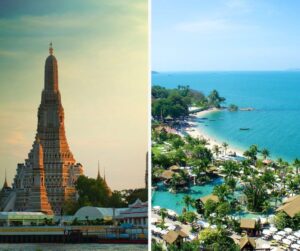
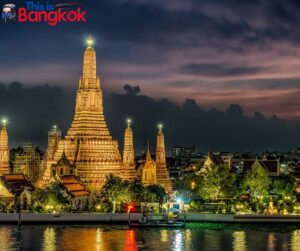
Wat Arun (Temple
of the Dawn)
Located
on the west bank of the Chao Phraya River Wat Arun can be reached
either by Arun Amarin Road or by crossing the river hy boat from
Tha Tien Pier near Wat Pho. The most attractive structure in this
temple is the 79 metre-high pagoda or "Phra Prang".
Wat Arun was restored during the brief Thonhuri period to he the
Royal Chapel of King Taksin. Despite its name "Temple of
the Dawn" the most beautiful view of it is from the Bangkok
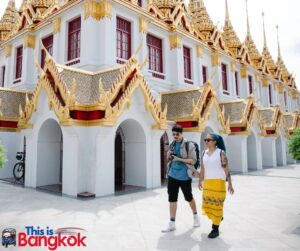
side of the river at sunset. Admission fee is Baht 10.
Wat Trimit
(Temple of the Golden Buddha)
At
the end of Yaowarat Road near Bangkok's Hualamphong Railway Station
is a temple situated on Traimit Road. This temple is known for
its famous Golden Buddha constructed during the Sukhothai period.
The image of solid gold is three meters high and weighs five and
a half tons. this image is open to the from 9.00 a.m.- 5.00 p.m.
Originally, this golden buddha image was completely covered with
plaster to conceal it from the enemy then invading Thailand and
was installed as the principal Buddha image in the main temple
building of Choti-naram Temple or Wat Phrayakrai, Yannawa District,
Bangkok in the third reign of the Chakkri Dynasty in the Ratanakosin
era. When Chotanaram Temple was deserted in about 1931, the East
Asiatic Company, with official permission, extended its operations
into the land area of the deserted temple. When the building was completed and while preparations
were being made to move this Golden Buddha image to the building,
the covering plaster was partly broken. Only then did the people
realize that it was a golden Buddha image. Thus, it has been treasured
for its historical, artistic and cultural values to this day.
Part of the covering plaster is also on display inside the temple
building.
Wat Benchamabophit
(The Marble Temple)
The Marble Temple is on Si Ayutthaya Road near Chitralada Palace.
The temple is well-known because its main building was constructed
during the reign of King Rama V. The best time to visit this temple
is early in the morning when Buddhist monks are chanting inside
the chapel. The interior of the main building is magnificently
decorated with cross beams of lacquer and gold. A large collection
of Bronze Buddhas lines the walls of the spacious inner courtyard.
The main building is open to visitors until 5.00 p.m. There is
an admission charge of Baht 10.
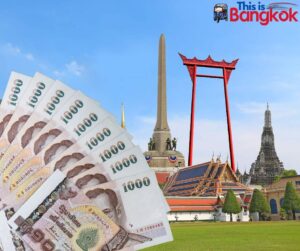
Wat Suthat
(The Giant Swing)
Located
on Bamrung Muang Road this temple took 27 years to build. It is
famous for the excellent murals in the main building from the
reign of King Rama III (1824-1851). The viharn should be seen
for its collection of gilded Buddha images. The temple complex
is open daily from 9.00 a.m.- 5.00 p.m. In front of the temple
is the famous Giant Swing. Many shops surrounding Wat Suthat stock
a very comprehensive range of Buddhist ecclesiastic supplies.
Wat Sa Ket
(The Golden Mount)
Wat
Sa Ket or the Golden Mount was begun during the reign of King
Rama I(1782-1800). The golden chedi houses relics of Lord Buddha
and affords visitors a panoramic view of Bangkok.
Wat Indravihan
Located in Bangkhunphrom area on Wisutkrasat Road Wat Indravihan
is well-known for a huge standing Buddha image. This image of
"Buddhasiariyametriya" is 32 metres tall(108.99 feet)
and 10 metres and 24 inches wide (40.09 feet). This Buddhist monument
was built during the reign of King Rama IV. The topknot of the
Buddha image contains a relic of Lord Buddha brought from Sri
Lanka. The temple is open to the public every day. There is no
admission fee.
Wat Thammamongkhon
Located on Sukhumvit Soi 101 this is the highest pagoda in Bangkok.
The pagoda 94.78 high, has 14 storey and an elevator to enable
visitors, particularly elderly people, to go to the top of the
building. Relics and a hair of the Lord Buddha, kept in the pagoda,
were presented by the Supreme Patriach of Bangladesh.
Wat Ratchanatdaram
Located
on Thanon Mahachai. This royal temple was built in the reign of
King Rama III in 1846. Loha Prasat (Metal Palace) one of its tourist
attractions standing on its 36 meters high with 37 surrounding
spires is the only one of its kind left in the world. Situated
in the nearby area are a royal pavilion for a guest welcome and
the memorial statue of King Rama III.
Wat Bowonniwet
The building is located on Phra Sumen Road, in Banglumphu area.
Built in 1829, it is the shrine-hall of Phra Phutthachinasri which
was molded in about 1357. Wat Bowon niwet is one of the most important
temples of Bangkok whose one-time chief abbot was King Rama IV
before he ascended the throne. Other Chakri Kings who had resided
here during their monkhood include King Rama Vl and King Rama
Vll as well as His Majesty King Bhumibol Adulyadej.
Wat Mahathat
(Temple of the Great Relic)
This is a very old temple on Na Phrathat Road between Silpakom
University and Thammasat University. The back of the temple faces
the Pramane Ground or Sanam Luang. Wat Mahathat was built during
the reign of King Rama I and houses Mahachulalongkorn Buddhist
University one of the two highest seats of Buddhist learning in
the country. Those interested in Buddhist meditation should visit
Section 5 which is the head-quarters of Wipassana (insight) meditation
inThailand. Information and practice in English can usually arranged
according to availability of suitable monks. The temple complex
is open from 9.00 a.m. to 5.00 p.m. On Buddhist holy days there
is a thriving open air market in the grounds and a comprehensive
selection of traditional Thai medicines usually in plant or root
form for sale.
 |
|